Subscribe & Get 10% Off
Join our community and receive a discount code for your first order!
Custom Software vs SaaS: Which Is Better for Your Business?
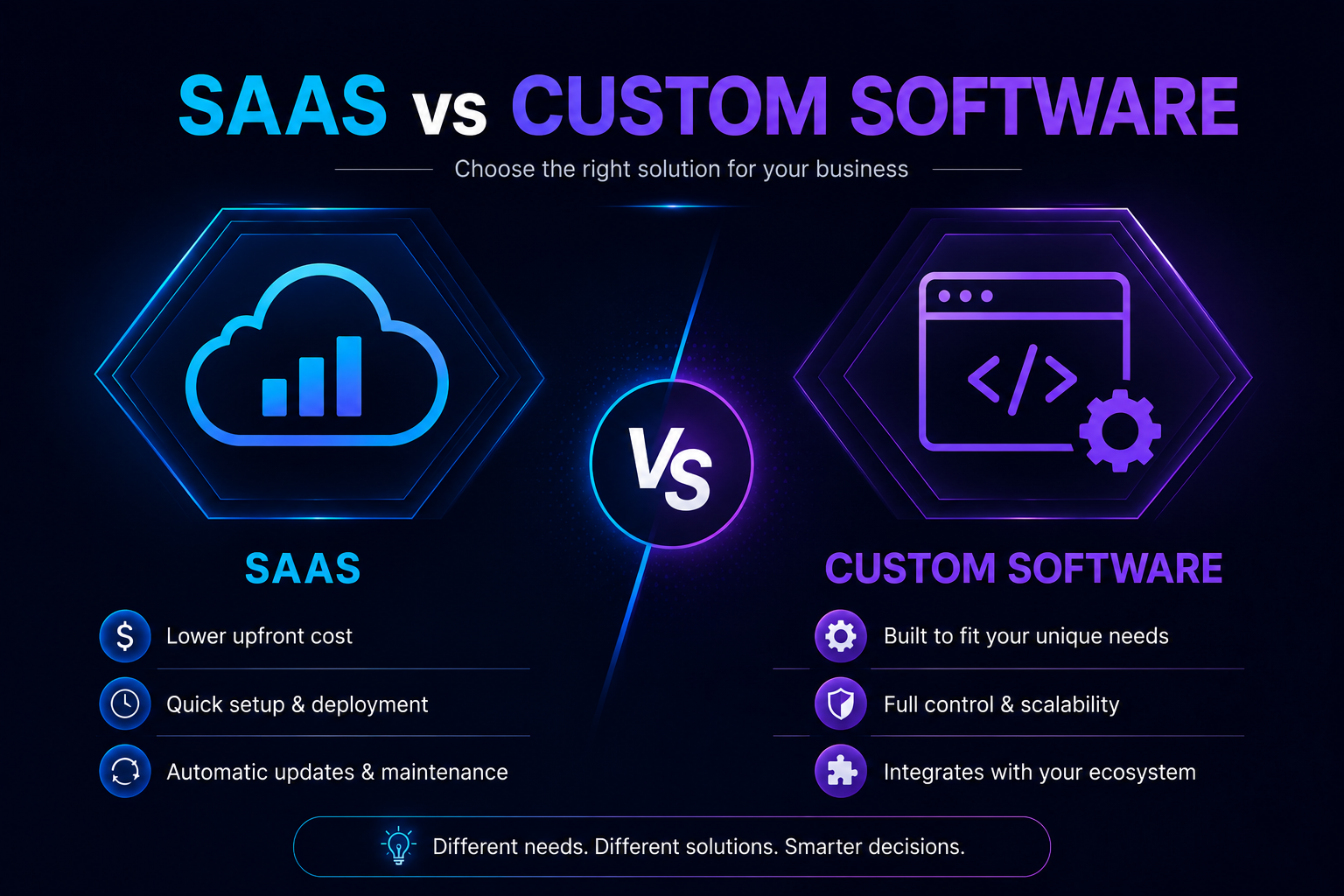
Custom Software vs. SaaS: The Decision That Will Shape Your Business for the Next Decade
Introduction
Choosing business software is no longer just an IT decision—it's one of the most important strategic decisions your company will make.
The software you choose today will influence how your employees work, how your customers experience your business, how efficiently your operations run, and how successfully your company scales in the years ahead.
Yet many organizations make this decision by asking a single question:
"Which option is cheaper today?"
While that may seem like a logical starting point, it rarely leads to the best long-term outcome.
A better question is:
"Which solution will create the most value for our business over the next five years?"
At first glance, Software as a Service (SaaS) appears to be the obvious choice. It's affordable, quick to implement, requires minimal technical expertise, and enables businesses to start operating almost immediately. For startups and small businesses, these advantages are difficult to ignore.
However, as organizations grow, a different reality often emerges.
Teams begin adopting separate SaaS applications for different departments. Customer information is stored in one system, accounting is managed in another, inventory lives somewhere else, and reporting depends on data collected from multiple platforms.
What started as a simple and cost-effective solution gradually turns into a complex network of subscriptions, disconnected data, manual processes, and increasing operational costs.
This is the point where many businesses begin asking a different question.
Instead of asking:
"Which software should we buy?"
They start asking:
"Should we build software that works the way our business actually operates?"
The answer depends on much more than budget. It depends on your growth strategy, operational complexity, customer expectations, and long-term business vision.
In this article, we'll explore both approaches—not just from a technology perspective, but from a business perspective—so you can make an informed decision that supports sustainable growth.
The Biggest Mistake Businesses Make When Choosing Software
When evaluating business software, most comparisons begin with a checklist of features:
Storage capacity
Number of users
Pricing plans
Integrations
Dashboards
AI capabilities
While these factors are important, they rarely determine whether a solution will truly help your business succeed.
The real question isn't what the software can do.
It's whether the software fits the way your business actually operates.
Imagine purchasing a premium suit that's one size too small.
The fabric may be exceptional, the craftsmanship flawless, and the design outstanding—but if it doesn't fit, you'll constantly struggle to wear it comfortably.
Many businesses make the same mistake when choosing software.
Instead of selecting technology that supports their workflows, they adjust their workflows to accommodate the software.
As a result:
Employees rely on spreadsheets because critical features are missing.
Managers create manual approval processes because automation is limited.
Sales teams duplicate customer information across multiple systems due to inflexible integrations.
Departments spend valuable time working around software limitations instead of focusing on meaningful work.
Over time, these small compromises evolve into permanent inefficiencies.
Ironically, organizations often assume their employees are the problem when, in reality, their software is creating unnecessary friction.
The best software doesn't simply help people complete tasks.
It removes obstacles, simplifies processes, and enables teams to perform at their best.
That's the difference between software that supports growth and software that silently slows it down.
The Hidden Cost Nobody Talks About: The SaaS Tax
There's a cost associated with SaaS that rarely appears in marketing materials.
We call it the SaaS Tax.
While it isn't an official financial term, it's a hidden expense that almost every growing business eventually pays.
The SaaS Tax is the combined cost of multiple software subscriptions that gradually become part of your monthly operating expenses.
It usually starts with one or two tools. Then, as your business grows, more platforms are added:
A CRM for customer management
Accounting software for finance
A project management platform
HR and payroll software
Customer support tools
Team communication platforms
Scheduling software
Document signing solutions
Marketing automation tools
Individually, each subscription appears affordable.
$20 per month here.
$50 per month there.
Another $100 somewhere else.
On their own, these costs seem insignificant.
But together, they can add up to thousands of dollars every month—before your business generates a single sale.
However, the subscription fees are only part of the problem.
The real cost lies in the operational complexity that comes with managing multiple disconnected systems.
Businesses must deal with:
Multiple user accounts and logins
Different permission structures
Inconsistent user interfaces
Separate support teams
Independent software updates
Different data formats
Limited integrations between platforms
As a result, employees spend more time switching between applications than performing meaningful work.
Instead of technology improving productivity, productivity becomes dependent on managing technology.
That's the true cost of the SaaS Tax.
Unfortunately, many organizations don't recognize this hidden expense until it becomes one of their largest operational costs.
SaaS Solves Today's Problems. Custom Software Solves Tomorrow's Challenges.
One of the biggest reasons businesses choose SaaS is speed.
You can subscribe today, complete a simple setup, and begin using the platform almost immediately.
For startups and businesses validating a new idea, this speed is a significant advantage.
But SaaS is designed for the masses—not for your business.
To serve thousands of customers, SaaS providers build products around common business requirements and standardized workflows.
Your business, however, is anything but standard.
You may have:
Unique approval processes
Custom pricing models
Specialized customer journeys
Industry-specific compliance requirements
Tailored reporting needs
Internal workflows that give you a competitive advantage
As your business grows, you may begin to notice that your software can no longer support the way you operate.
The question changes from:
"Can our business continue to grow?"
to:
"Can our software keep up with our growth?"
That's the moment custom software becomes more than a technology investment.
It becomes a strategic business asset.
Unlike off-the-shelf solutions, custom software is built around your organization—not the other way around.
It adapts to your processes instead of forcing your teams to change how they work.
As your company evolves, your software evolves with it.
New features can be added as your business grows, workflows can be refined, and integrations can be developed specifically for your operational needs.
Perhaps most importantly, custom software creates capabilities that competitors can't simply purchase with a monthly subscription.
Instead of relying on the same tools as everyone else, your business gains technology designed exclusively around its strengths.
That's where custom software transforms from an operational tool into a lasting competitive advantage.
The Moment Businesses Outgrow SaaS
Most organizations don't decide overnight to replace every software platform they use.
The transition happens gradually.
In the beginning, everything works as expected.
A CRM manages customer relationships.
Accounting software handles finances.
Project management tools organize daily work.
Communication platforms keep teams connected.
For a while, these systems work well together.
But as the business expands, cracks begin to appear.
Employees start exporting spreadsheets because applications don't communicate effectively.
Managers request manual reports because dashboards lack the insights they need.
Departments maintain separate databases because integrations don't fully support their workflows.
Eventually, businesses begin hiring employees simply to transfer information from one platform to another.
At this point, software is no longer reducing work—it is creating it.
This is what we call the SaaS Ceiling.
It's the stage where adding another subscription no longer improves efficiency.
Instead, it increases complexity, operational costs, and administrative overhead.
The businesses that continue scaling successfully don't keep purchasing new tools.
They simplify.
They consolidate.
They build systems that work together.
For many organizations, this becomes the turning point where investing in custom software is no longer a luxury—it's the smarter long-term business decision.
The 5-Year Cost Curve Nobody Calculates
One of the biggest misconceptions about business software is that the option with the lowest upfront cost is always the most affordable.
In reality, software should be evaluated like any other long-term business investment—not just by its initial price, but by its Total Cost of Ownership (TCO) over time.
A low monthly subscription may seem attractive today, but the long-term financial impact often tells a different story.
Consider a growing company with 50 employees using multiple SaaS platforms:
A CRM for customer management
Project management software
HR and payroll systems
Accounting software
Customer support tools
Email marketing platforms
Scheduling software
Digital document signing
Workflow automation solutions
Each platform charges a monthly subscription, often based on the number of users.
Initially, these costs appear manageable.
However, as your team grows, every new employee increases your monthly software expenses. What once seemed inexpensive gradually becomes a significant operational cost.
The financial impact doesn't stop there.
Businesses also absorb several hidden expenses that rarely appear on invoices, including:
Employees switching between multiple applications throughout the day
IT teams managing numerous vendors and software licenses
Managers manually reconciling data from different systems
Departments creating workarounds because applications don't communicate effectively
Additional training required for every new platform
Although these costs aren't listed as subscription fees, they reduce productivity and consume valuable business resources every single day.
A Typical Five-Year Cost Comparison
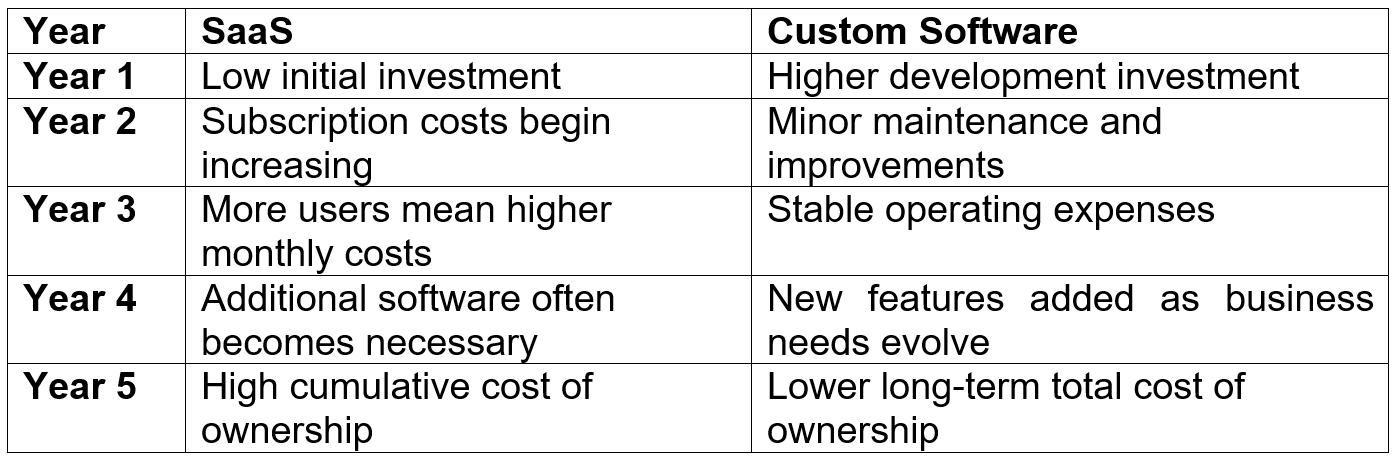
Custom software generally requires a larger investment at the beginning.
However, unlike subscription-based platforms, it becomes a business asset that evolves alongside your organization instead of becoming more expensive each year.
The real question isn't:
"Which option costs less today?"
It's:
"Which option delivers the greatest value over the next five years?"
That shift in perspective often changes the decision entirely.
Software Debt: The Silent Growth Killer
Most business leaders are familiar with the concept of technical debt.
Far fewer recognize another challenge that's equally damaging:
Software Debt.
Software debt develops when every new business challenge is solved by purchasing another application.
A tool for sales.
Another for HR.
Another for accounting.
Another for reporting.
Another for document management.
Another for workflow automation.
Each purchase solves an immediate problem.
Collectively, however, they create a disconnected technology ecosystem.
Over time, employees find themselves opening ten or more applications just to complete a single workflow.
Customer information exists in multiple locations.
Reports don't always match.
Departments maintain separate versions of the same data.
Managers spend more time verifying information than using it to make strategic decisions.
Software debt doesn't appear overnight.
It grows gradually until the business becomes dependent on systems that were never designed to work together.
Ironically, the company believes it is becoming more digital.
In reality, it is becoming more complicated.
Successful digital transformation isn't measured by the number of software platforms your business uses.
It's measured by how seamlessly information flows across your organization.
When your systems communicate effortlessly, your people can focus on creating value instead of managing software.
Your Business Doesn't Need More Features—It Needs Fewer Systems
One of the biggest myths in business technology is that more features automatically create more value.
They don't.
Every unnecessary feature introduces additional complexity.
Employees require more training.
Navigation becomes more confusing.
User adoption decreases.
Productivity suffers.
The most efficient organizations aren't those using the largest number of software tools.
They're the ones using the right tools.
Instead of asking:
"Which platform has the most features?"
Ask a more meaningful question:
"Which solution removes the most friction from our daily operations?"
This subtle shift in thinking can completely change how businesses evaluate technology.
Custom software isn't valuable because it offers unlimited functionality.
It's valuable because it provides exactly the functionality your business needs—and nothing it doesn't.
That simplicity becomes one of its greatest strengths.
Employees learn the system faster.
Workflows become more intuitive.
Training costs decrease.
Adoption improves.
Productivity increases.
In today's competitive business environment, simplicity isn't a limitation.
It's a strategic advantage.
When SaaS Is the Better Choice
Despite the limitations we've discussed, SaaS remains an excellent solution for many businesses.
In fact, choosing custom software too early can be just as costly as relying on SaaS for too long.
If you're launching a startup, validating a new business idea, or operating with limited resources, SaaS provides exceptional value. It allows businesses to move quickly, minimize upfront investment, and focus on growth rather than software development.
SaaS is often the right choice when:
You're still testing your business model.
Your internal processes are relatively straightforward.
You need a solution within days—not months.
Your team is small and growing.
Your competitive advantage doesn't rely on unique workflows.
Industry-standard processes meet your operational needs.
There's no benefit in building custom software simply because it sounds more advanced.
The smartest businesses choose technology that aligns with their current stage of growth while keeping future scalability in mind.
When Custom Software Becomes the Smarter Investment
Every growing business eventually reaches a point where software should adapt to the business—not the other way around.
This transition usually happens when operational complexity begins limiting growth.
If your organization is experiencing any of the following, it may be time to consider custom software:
Multiple disconnected SaaS subscriptions
Duplicate data entry across departments
Manual approval workflows
Employees relying heavily on spreadsheets
Reports created by combining data from multiple systems
Rising subscription costs year after year
Frequent requests for features your current software doesn't support
Teams working in isolated systems with limited collaboration
These aren't simply technology challenges.
They're indicators that your business has outgrown its existing software ecosystem.
Custom software addresses the root cause by streamlining operations, centralizing data, and creating workflows designed specifically for your organization.
Instead of adding another application, it simplifies the way your business operates.
A Simple Decision Framework for Business Owners
Rather than asking whether SaaS or Custom Software is better, ask yourself these five questions:
Will this software still support our business three to five years from now?
Are we paying for features our team never uses?
Are employees creating manual work because the software has limitations?
How much time is lost switching between different platforms every day?
Does this software create a competitive advantage—or simply help us keep up?
If most of your answers point toward operational friction, custom software deserves serious consideration.
Technology should remove obstacles—not create new ones.
A Real-World Business Scenario
Imagine a healthcare company with approximately 60 employees.
At first glance, everything appears to be working well.
The sales team manages customer relationships through a CRM.
Finance handles invoicing with separate accounting software.
HR uses another platform for attendance and payroll.
Appointments are scheduled through a dedicated booking system.
Patient records are stored in specialized healthcare software.
Management prepares reports by exporting data into spreadsheets.
Nothing is technically broken.
Yet employees spend countless hours transferring information between systems, correcting duplicate data, and generating manual reports.
Instead of purchasing another subscription to connect these platforms, the company decides to invest in a custom business solution.
The results are immediate.
Customer and patient information flows automatically across departments.
Invoices are generated instantly.
Appointments synchronize in real time.
Management dashboards update automatically.
Administrative work is significantly reduced.
The greatest benefit isn't simply lower costs.
It's operational clarity.
Everyone works with the same information.
Everyone follows the same processes.
Everyone makes better decisions.
And ultimately, everyone works more efficiently.
The Competitive Advantage Most Businesses Overlook
Technology alone rarely creates a competitive advantage.
How your business uses technology does.
If your competitors rely on the same SaaS platforms, the same workflows, and the same processes, your software is unlikely to differentiate your business.
Custom software changes that.
It enables organizations to build workflows and customer experiences that competitors can't simply purchase through a monthly subscription.
Whether it's:
AI-powered automation
Custom approval workflows
Industry-specific reporting
Intelligent customer portals
Personalized user experiences
Advanced operational dashboards
Custom software transforms technology from a standard business tool into a strategic competitive asset.
In highly competitive markets, that advantage can be the difference between leading the industry and struggling to keep pace.
Why Businesses Choose BalanceBit Solutions
At BalanceBit Solutions, we believe technology should work for your business—not the other way around.
That's why every project begins with understanding your organization, your workflows, your challenges, and your long-term objectives.
Rather than forcing businesses into generic software, we design solutions that align with the way they already operate while preparing them for future growth.
Our expertise includes:
Custom Software Development
Custom CRM Solutions
ERP Development
AI Business Automation
Business Process Automation
Cloud-Based Applications
Enterprise System Integration
Workflow Optimization
Custom Dashboards & Reporting
Every solution we build is designed to simplify operations, improve productivity, and support sustainable business growth.
Final Thoughts
Choosing between SaaS and Custom Software isn't about deciding which technology is better.
It's about determining which solution best supports your business today—and positions it for tomorrow.
For startups and businesses with straightforward operational needs, SaaS offers speed, flexibility, and affordability.
For growing organizations managing increasingly complex workflows, custom software can become a long-term strategic investment that improves efficiency, reduces operational costs, and creates a lasting competitive advantage.
Before making your next software decision, don't just compare features or subscription prices.
Consider the bigger picture.
Ask yourself whether your software is helping your business grow—or quietly limiting its potential.
The right technology shouldn't simply support your business.
It should become one of its greatest competitive strengths.
Ready to Build Software That Grows With Your Business?
At BalanceBit Solutions, we help businesses move beyond disconnected tools and build intelligent software tailored to their unique operations.
Whether you're evaluating SaaS, planning a digital transformation, or exploring a custom software solution, our team is here to help you make the right decision.
Let's build technology that works the way your business does.